

If you’re a decent writer, you already have a skill that can turn directly into income – no special tools, no upfront investment, and no business experience required.
Learning how to get paid to write articles is one of the most accessible ways to make money online, because all you really need is a computer, an internet connection, and the ability to express your thoughts clearly.
But just like in any field, there’s a big difference between paid writing jobs that compensate you fairly and those that eat up your time for pocket change.
In this article, we cover seven proven freelance writing platforms , from options that welcome anyone who writes fluently, to platforms that pay experienced authors hundreds of dollars per article.
Whether you’re just starting out or already have some experience, this guide will help you find the right platform to make money writing online at your current skill level.
1. Textbroker : A Great Starting Point for New Writers
Textbroker is a legitimate platform that has been around since 2005 and has paid out hundreds of thousands of writers worldwide.

It’s a content mill platform, meaning clients order articles and writers produce them according to given guidelines.
The system runs on a star-rating scale from 2 to 5. New writers start with lower ratings and lower pay, but as they write more and improve, their rating – and their per-word rate – increases.
Pay ranges from $0.007 to $0.05 per word depending on your rating.
Textbroker is especially beginner-friendly since there are no strict application requirements. A short writing test is all it takes to get started. Payments are made weekly via PayPal for writers outside the US.
Realistic earnings: $50–$200 per month for beginners; significantly more for higher-rated writers.
Availability: Writers from around the world, including Europe.
2. Medium Partner Program : Writing for Your Own Audience
Medium is one of the most popular blogging and writing platforms in the world. Writers in the Medium Partner Program earn based on the amount of time readers spend on their articles, roughly $20 per 1,000 views.
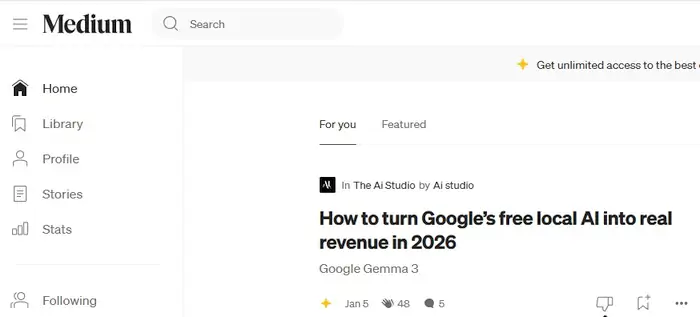
You could call this blogging for money.
The advantage of Medium is freedom — you write about topics you’re passionate about, with no client briefs or deadlines. The downside is that it takes time to build an audience that generates consistent income.
To join the Partner Program you need at least 100 followers, and payouts go through a Stripe account, which isn’t available in every country.
For writers who can’t access Stripe, Medium can still be a great place to build a portfolio and reputation, even without direct earnings.
Realistic Medium earnings: $5–$50 per month for beginners; experienced writers with a large following earn considerably more.
Availability: Global, though payouts are limited to countries supported by Stripe.
3. Upwork : The Freelance Marketplace With the Most Clients
Upwork is one of the largest freelance marketplaces in the world, offering a wide range of writing jobs – from short blog posts and product descriptions to long-term collaborations with companies looking for a dedicated content writer.
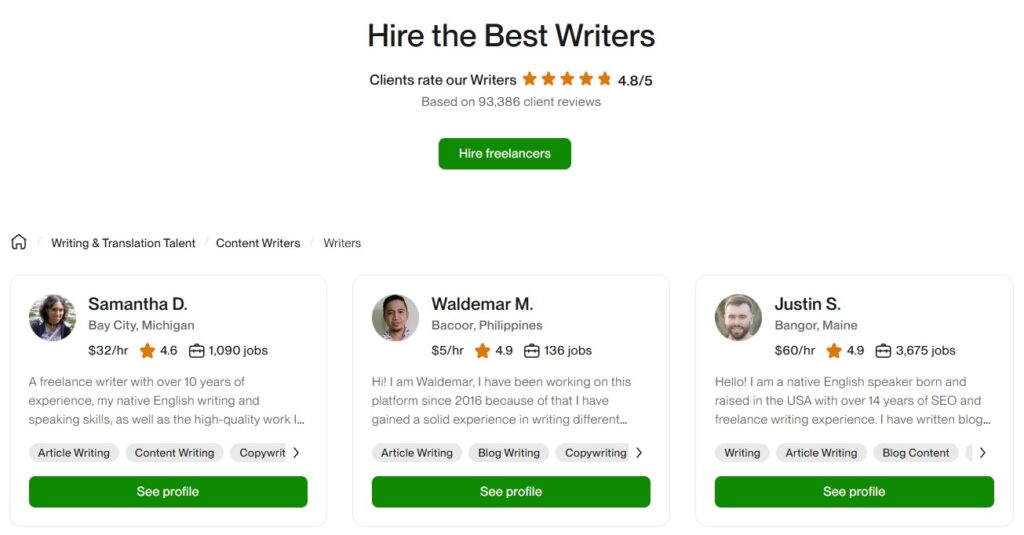
This is one of the best-known freelance writing platforms for building a long-term career.
Getting started on Upwork takes a bit more effort. You’ll need to build a compelling profile, write strong project proposals, and land your first reviews.
But once you’ve built a reputation, the platform offers some of the better rates in freelance writing.
Pay varies by project – smaller gigs start around $10, while larger contracts can exceed $500.
Payments are made via PayPal, bank transfer, or Payoneer, and the platform charges a 10% service fee.
Realistic earnings: $100–$1,000+ per month depending on your project load and experience.
Availability: Global.
4. iWriter – A Simple Way In, No Test Required
iWriter is a content mill platform similar to Textbroker, but with a slightly different system. Writers can sign up and start writing immediately without taking a test first – a big plus for anyone who wants to get going quickly.

Pay ranges from $0.014 per word for beginners up to $0.02 for more experienced writers.
The platform pays weekly via PayPal, and the minimum payout is just $1, meaning you can test the payment system right away without a long wait.
Realistic earnings: $30–$150 per month for regular entry-level writers.
Availability: Global.
5. Freelancer.com : Bidding for Projects
Freelancer.com is one of the world’s largest freelance platforms, connecting millions of freelancers with companies looking for writers, designers, and technical experts.
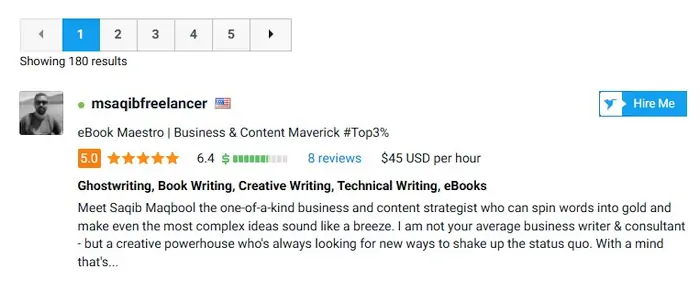
Unlike some other platforms, here you actively search for projects and submit bids to clients yourself.
The advantage of Freelancer.com is its enormous client base and variety of projects, from short web copy to long-term collaborations.
The downside is fierce competition, especially for beginners who don’t yet have reviews or a portfolio.
The platform charges a 10% fee and offers a subscription for premium features, though a free basic account is enough to get started.
Realistic earnings: Ranges from $10 for a short piece to $500 for more complex projects.
Availability: Global.
6. Substack : A Newsletter That Actually Pays
Substack lets you run your own newsletter with subscribers who pay for access to your content.
The model is simple: some content is free, while premium articles are reserved for paying subscribers.
Substack keeps 10% of subscription revenue, and the rest goes to the writer. The key to success on Substack is building a loyal readership, which takes consistency and quality.
The platform is especially popular among journalists, analysts, and writers covering niche topics.
Realistic earnings: From token amounts starting out to thousands of dollars per month for established writers with a large subscriber base.
Availability: Global, payouts via Stripe.
7. High-Paying Platforms for Experienced Writers
For writers who already have experience and want top-tier rates, there are platforms and publications that pay significantly more.
Copyhackers pays between $300 and $1,000 per article on copywriting and marketing, while Narratively pays $300 to $1,000 for personal essays and in-depth features.

These platforms don’t accept every writer. They look for experience, original ideas, and high writing quality.
But if you have something worth saying and know how to say it well, it’s worth trying , a single accepted article can pay more than a week of writing on other platforms.
Realistic earnings: $100–$1,000+ per article.
Availability: Mainly US and UK markets, English-language content.
Platform Comparison Table
| Platform | Pay per Article | Payout | Availability | Best For |
|---|---|---|---|---|
| Textbroker | $5 – $50 | PayPal, weekly | Global | Beginners |
| iWriter | $2 – $20 | PayPal, weekly | Global | Beginners |
| Medium | Variable | Stripe, monthly | Global* | Bloggers |
| Upwork | $10 – $500+ | PayPal, Payoneer | Global | All levels |
| Freelancer.com | $10 – $500+ | PayPal, bank transfer | Global | All levels |
| Substack | Variable | Stripe, monthly | Global* | Journalists, analysts |
| Premium platforms | $100 – $1,000+ | PayPal, bank transfer | US/UK | Experienced writers |
*Payout limited to countries supported by Stripe
How to Get Started : Practical Tips
Whichever platform you choose, a few things are worth keeping in mind from day one.
Build a short portfolio before you apply to get paid to write articles.
Even three to five well-written pieces on a topic you care about, published on a free blog or Medium profile, look far more convincing than an empty profile.
Start with platforms that have a lower barrier to entry, like Textbroker or iWriter, and gradually build experience and reviews.
With your first reviews in hand, it becomes much easier to land better projects on platforms like Upwork.
Specializing pays off. Writers who cover specific topics — finance, health, technology, law — earn significantly more than generalists, because clients are looking for experts, not just writers.
Frequently Asked Questions

Get the latest news!
Useful tips directly to your inbox – once a week, free of charge.
Conclusion
Getting paid to write articles isn’t a myth. Millions of freelancers around the world write content every day and get paid for it regularly.
The real difference between those who succeed and those who give up usually isn’t talent , it’s patience and consistency.
Learning to make money writing online is a skill that improves over time. Every article you write is better than the last one, and every satisfied client is a potential source of long-term, recurring work.
Know a platform we missed? Drop it in the comments and help others discover it too! We’d love to hear your recommendations.
Am good to work with