
NELMEDIA
What Is SEO Optimization: A Complete Beginner’s Guide to Ranking on Google 2026
Do you have a website but no visitors?
A YouTube channel that nobody watches?
An online store with barely any sales?
You post regularly on social media but it feels like no one is reading? You sell your photos online but haven’t made a single sale yet?
Although the reasons can vary, there is a good chance you have not done even the most basic SEO optimization.

SEO optimization is the process of improving your website so that it appears higher in search engine results , primarily Google , when people search for topics related to your content, products or services. More visibility means more organic (unpaid) traffic, more readers and ultimately more revenue.
Understanding what SEO is and how it works is essential knowledge for anyone running a blog, website or online business. If you are a blogger trying to reach more readers, a freelancer building a portfolio or an e-commerce seller looking to attract buyers, SEO optimization directly determines how many people find you through search.
This guide explains SEO from the ground up , no jargon, no assumptions of prior knowledge.
What Is SEO and Why Does It Matter?
SEO stands for Search Engine Optimization. It is the practice of making your website more understandable and attractive to search engines so they rank it higher in results – and more attractive to real users so they actually stay and engage once they arrive.

When someone types a query into Google, the search engine’s algorithm processes hundreds of signals to decide which pages to show and in what order. SEO optimization is the discipline of aligning your website with those signals.
Why SEO matters in numbers:
- The first result on Google gets approximately 27–30% of all clicks
- Results on the first page receive over 90% of all traffic – page two barely exists for most users
- Organic search drives 300% more traffic than social media on average
- SEO traffic is free and compounds over time , unlike paid advertising which stops the moment you stop paying
SEO vs. paid advertising: Paid ads (Google Ads, Facebook Ads) generate traffic immediately but cost money every day. SEO optimization requires upfront time investment but generates traffic continuously and for free once rankings are established. The two approaches complement each other – SEO is the long-term foundation.
How Do Search Engines Work?
Understanding how search engines function helps you make better SEO decisions. The process has three stages:
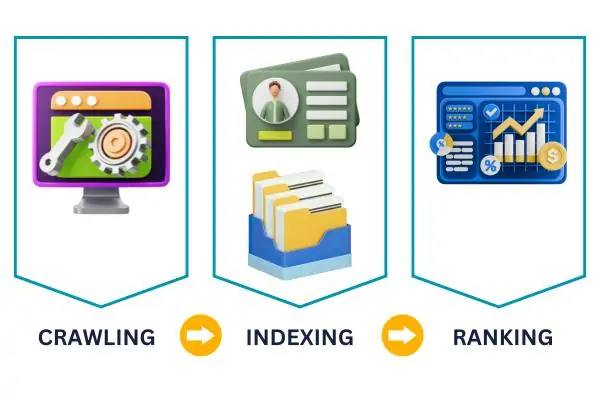
Crawling – Search engines use automated programs called web crawlers (or spiders) to systematically browse the internet. These crawlers follow links from page to page, reading content and collecting data. Every website that search engines can access gets crawled regularly.
Indexing – After crawling a page, search engines store the collected data in a massive database called the index. Think of it as a library catalogue – the index contains information about every indexed page including its content, links, keywords and technical characteristics. If your page is not in the index, it cannot rank for anything.
Ranking – When a user enters a search query, the search engine’s algorithm analyses the query and scans its index to find the most relevant, authoritative and trustworthy pages. It then orders those results from most to least relevant. This ordering is determined by hundreds of ranking factors – and improving those factors is the core work of SEO optimization.
The Key Elements of SEO Optimization
SEO optimization has four main pillars. Strong performance across all four is what separates well-ranking pages from those that never appear on page one.
1. Keyword Research for Beginners
Keywords are the specific words and phrases that people type into search engines. Keyword research is the process of identifying which terms your target audience uses and how competitive those terms are.
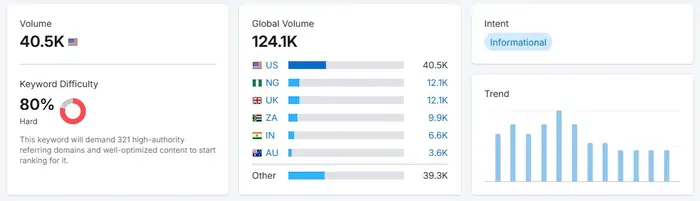
Search intent is the most important concept in keyword research. Every search query has an intent behind it:
- Informational – the user wants to learn something (“what is SEO optimization”)
- Navigational – the user wants to find a specific website (“Nelmedia blog”)
- Commercial – the user is researching before buying (“best SEO tools 2026”)
- Transactional – the user wants to buy or take action (“buy Semrush subscription”)
Creating content that matches search intent is more important than keyword density. A page about “what is SEO optimization” must comprehensively answer the question – not just mention the phrase repeatedly.
Key metrics in keyword research:
Search volume – how many times per month a term is searched. High volume means more potential traffic but also typically more competition.
Keyword difficulty (KD) – how hard it is to rank for a term based on the authority of currently ranking pages. For new websites with low domain authority, targeting low-KD keywords is essential.
Long-tail keywords – longer, more specific phrases (e.g. “how to do keyword research for a blog”) have lower search volume but also much lower competition and higher conversion rates. For beginners and low-authority sites, long-tail keywords are the primary opportunity.
Free tools for keyword research:
- Google Search Console (shows what you already rank for)
- Google’s autocomplete and “People Also Ask” sections
- Ubersuggest (free tier)
- Answer The Public
Paid tools:
- Semrush – the most comprehensive SEO platform available
- Ahrefs – particularly strong for keyword and backlink research
➡ What is Semrush and how to use it
➡ What is Google Search Console and how to use it
2. On-Page SEO
On-page SEO refers to all optimizations you make directly within individual web pages to improve their relevance and usability for both users and search engines.
Title tag – the HTML element that defines the title of a page. It appears as the blue clickable headline in search results. Every page needs a unique, descriptive title that contains the primary keyword. Best practice: keep it under 60 characters so it does not get truncated in search results.
Meta description – the short paragraph of text shown below the title in search results. While Google does not use it as a direct ranking factor, a well-written meta description significantly improves click-through rate (CTR). Keep it under 155 characters and include a clear benefit or call to action.
Headings (H1, H2, H3) – heading tags structure your content for both readers and search engines. Each page should have one H1 (main title containing the primary keyword) and multiple H2/H3 subheadings that organize the content logically. Secondary keywords placed naturally in H2 headings signal topical depth to Google.
URL structure – clean, descriptive URLs help both users and search engines understand page content. Use short, keyword-containing URLs with hyphens between words. Avoid numbers, parameters or random strings.
Image alt text – alternative text describes images for search engines (which cannot see images) and screen readers (accessibility). Every image should have a descriptive alt text that includes a relevant keyword where natural.
Content quality and length – Google’s algorithm increasingly rewards content that fully answers the user’s question. This usually means comprehensive, well-structured content that covers a topic in depth. Thin content (a few hundred words that barely scratches the surface) rarely ranks well for competitive queries.
Internal linking – linking between your own pages passes authority (often called “link juice”) and helps search engines understand the structure and hierarchy of your website. Internal links also keep users on your site longer. Always use descriptive anchor text that describes what the linked page is about.
3. Technical SEO Basics
Technical SEO covers the behind-the-scenes aspects of your website that affect how search engines can access, crawl, index and understand your content.
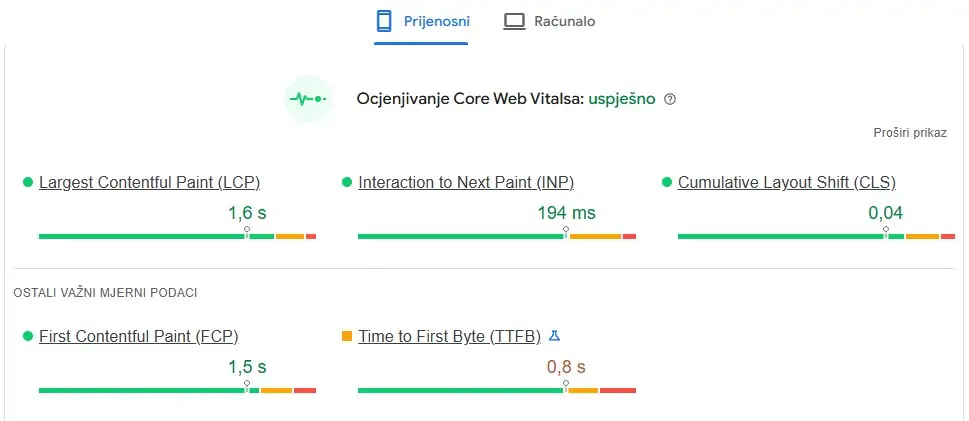
Page loading speed – Google uses page speed as a direct ranking factor and a component of Core Web Vitals. Slow pages frustrate users and are penalised in rankings. Key optimisations include compressing images, enabling browser caching, using a fast hosting provider and minimising unused CSS and JavaScript.
Mobile-friendliness – Google uses mobile-first indexing, meaning it primarily uses the mobile version of a page for ranking and indexing. Your website must be fully responsive and usable on all screen sizes.
Core Web Vitals – Google’s set of user experience metrics that directly affect rankings. The three key metrics are LCP (Largest Contentful Paint – loading speed), FID/INP (interactivity) and CLS (Cumulative Layout Shift – visual stability). You can check your Core Web Vitals scores in Google Search Console.
SSL certificate (HTTPS) – Google explicitly favours HTTPS websites over HTTP. An SSL certificate encrypts data between the user’s browser and your server. Most modern hosting providers include free SSL certificates via Let’s Encrypt.
XML sitemap – a file that lists all your important pages, helping search engines discover and crawl your content efficiently. WordPress sites can generate sitemaps automatically via the Yoast SEO or Rank Math plugin.
Robots.txt – a file that tells search engine crawlers which pages to access and which to ignore. Incorrectly configured robots.txt can accidentally block search engines from your entire site.
Structured data (Schema markup) – additional HTML code that provides explicit information about your page’s content to search engines. Schema markup enables rich results (like star ratings, FAQ dropdowns or breadcrumbs) in search results, which significantly improve click-through rates.
4. Off-Page SEO – Backlinks for Beginners
Off-page SEO refers to actions taken outside your own website that influence your rankings – primarily the acquisition of backlinks.
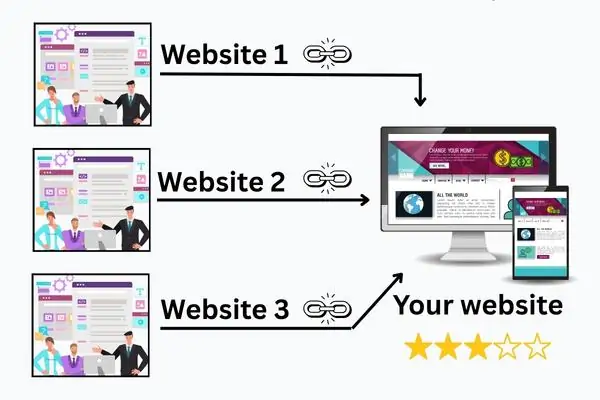
What is a backlink? A backlink is a link from another website pointing to yours. Google treats backlinks as votes of confidence – if reputable sites link to your content, it signals that your content is trustworthy and valuable. The more high-quality backlinks your site accumulates, the higher your domain authority grows.
Domain Authority (DA) – a third-party metric (developed by Moz) that predicts how likely a website is to rank in search results based on its backlink profile. DA ranges from 1 to 100. New websites start at DA 1–5. Building to DA 20–30 requires consistent content and link building over months to years.
Quality over quantity – one backlink from a highly authoritative website (a major news publication, a university, a government site) is worth more than hundreds of links from low-quality directories or irrelevant blogs.
Legitimate link building strategies for beginners:
- Create genuinely useful content that others naturally want to link to (infographics, original data, comprehensive guides)
- Guest posting on relevant websites in your niche
- Getting listed in legitimate industry directories
- Building relationships with other content creators in your field
- Being cited as a source when your original research or statistics are referenced
What to avoid: buying links, participating in link exchanges, using private blog networks (PBNs). These are black hat techniques that violate Google’s guidelines and can result in manual penalties that devastate your rankings.
SEO for Bloggers : Practical Application
For bloggers and content creators, SEO optimization translates into specific, actionable habits:

Before you write:
- Research the keyword you are targeting and analyse the top 5–10 ranking pages
- Understand the search intent – are people looking for a quick answer, a detailed guide or a comparison?
- Identify related keywords and questions to cover (use Google’s “People Also Ask” section)
While you write:
- Include the primary keyword in the H1, within the first paragraph, in at least one H2 and naturally throughout the text
- Write for readers first – keyword stuffing actively harms rankings today
- Use short paragraphs (3–4 sentences maximum), bullet points and subheadings to improve readability
- Aim for comprehensive coverage of the topic
After you publish:
- Add the page to your XML sitemap (automatic with Yoast/Rank Math)
- Build internal links from other relevant posts on your site
- Share on social media and relevant communities to generate initial traffic signals
- Monitor performance in Google Search Console
➡ How to build a website or blog
How to Rank on Google – What Actually Matters in 2026
Google’s algorithm evaluates hundreds of factors, but research consistently shows that these are the most impactful:
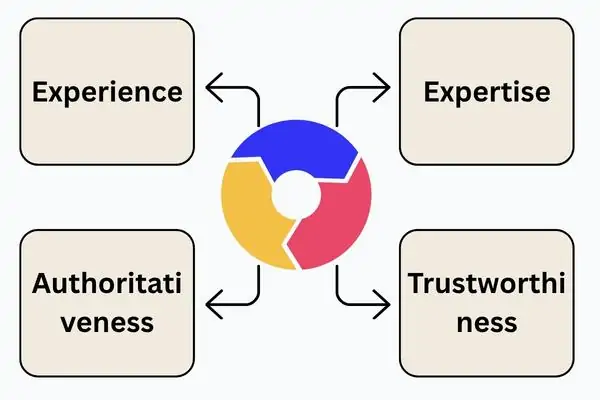
E-E-A-T (Experience, Expertise, Authoritativeness, Trustworthiness) – Google’s framework for evaluating content quality. Demonstrate genuine expertise through depth of knowledge, cite sources, show credentials where relevant and build a trustworthy site with clear authorship, privacy policy and contact information.
➡Read what Miroslav Varga Google Certified Trainer and Martech Specialist say about goals
Content that fully satisfies search intent – the single most important factor. If your page comprehensively answers what the user is looking for better than competing pages, Google will reward it.
Page experience signals – fast loading, mobile-friendly, visually stable (no layout shifts), HTTPS.
Backlink profile – both quantity and quality of sites linking to you.
User engagement signals – click-through rate from search results, time on page, bounce rate. A page that people click on and stay to read signals relevance to Google.
Content freshness – regularly updated content performs better than stale pages, especially for topics that change over time.
Essential SEO Tools
Google Search Console (free) – the most important SEO tool available and completely free. Shows which queries bring users to your site, which pages rank for which keywords, crawl errors, indexing status and Core Web Vitals performance.
➡ What is Google Search Console and how to use it
Google Analytics (free) – tracks user behaviour on your site – traffic sources, page views, bounce rates, conversion tracking.
➡ How to activate Google Analytics
Semrush (paid, free tier available) – comprehensive SEO platform covering keyword research, competitor analysis, site audit, rank tracking and backlink analysis. One of the most powerful tools available for serious SEO work.
Rank Math SEO / Yoast SEO(WordPress plugins, free) on-page SEO assistants that help optimize title tags, meta descriptions, XML sitemaps and readability directly within WordPress.
Ahrefs (paid) – particularly strong for keyword research, content gap analysis and backlink research.
AI and SEO in 2026
Artificial intelligence is transforming search. Google’s AI Overviews (formerly SGE) now answer many queries directly in search results – sometimes without users clicking through to websites at all. This makes Generative Engine Optimization (GEO) an emerging consideration alongside traditional SEO.
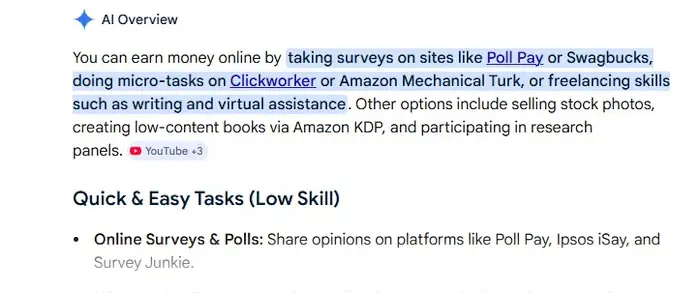
Practical implications for content creators:
- Focus on content that provides genuine expertise and first-hand experience – AI summaries often lack this
- Structure content clearly with well-organized headings and concise answers to specific questions
- Build brand authority – Google’s AI is more likely to cite and recommend recognized, authoritative sources
- Structured data (Schema markup) helps AI systems understand and extract information from your pages
The fundamentals of SEO optimization – quality content, technical health, genuine authority , remain the foundation. AI changes the landscape, not the underlying principles.
An increasing number of platforms are introducing dedicated sections for AI search optimization. For example, HubSpot has added HubSpot AEO to its suite, allowing you to see how your brand appears in ChatGPT, Gemini, and Perplexity, identify where competitors are outperforming you, and understand exactly how to close the gap.
SEO Optimization : FAQ

Get the latest news!
Get useful tips in your inbox once a week. Free. Just useful stuff.
Conclusion
The basic principles of SEO are not complicated. It starts with understanding what your audience is searching for, then creating helpful, high-quality content that clearly answers their questions. Along with this, it is important to have a technically sound website and to gradually build trust and authority through quality content and genuine backlinks.
We hope this introduction to SEO optimization has been useful and that you have learned something new. However, this is not the end of the topic. On other pages, we explain individual SEO elements and tools in more detail, while real-world examples and practical tips can be found on our blog.
Please ask your questions in the comments below.
Related reading:
- What is Google Search Console andhow to use it?
- New Semrush Tools for SEO and Marketing: Revolutionary Updates for 2025.
- HubSpot: Top 10 Best Free AI Tools
- Rank Math: 10 Tips for Excellent SEO Results
- How to use Google Keyword Planner tool?
- Affiliate Marketing: Guide to Earning Passive Income Online
- Earn Money Online: Best Ways in 2026
Thanks for sharing your knowledge on SEO. In 2023 it has become really important.
Yooh Carls thank you for your comment. Stay tuned because there will be more articles on this topic as well as concrete examples on the blog.