
NELMEDIA
What Is Freelancing: A Complete Guide to Freelancing for Beginners
Freelancing for beginners can feel overwhelming at first , but the concept itself is simple. Freelancing means offering your skills as a service to multiple clients, without being tied to a single employer, a fixed office, or a set schedule.

You choose your clients, set your own rates, and work whenever, and wherever you want.
Sounds a bit like a dream, right?
Well, for millions of people, it’s just a normal Tuesday.

According to global research, more than 1.5 billion people around the world now work as freelancers, and that number keeps climbing every single year.
Clearly, this isn’t a trend anymore – it’s a shift.
Freelancing vs. Being an Employee (Yes, There’s a Difference)
In the United States alone, over 70 million people freelanced in 2025, contributing more than $1.27 trillion to the economy. That’s not side-hustle money. That’s “this-is-a-real-career” money.
If you’re tired of the 9-to-5 routine, want extra income, or dream of working from anywhere with decent Wi-Fi, freelancing for beginners is one of the easiest paths to start. No startup capital. No fancy degree. No location limits. Just skills and consistency.
In this guide, you’ll learn the basics without the fluff: how to pick a skill, build a portfolio, choose the right platform, and land your first client (yes, even if you feel totally unqualified right now).
What Is Freelancing , and Who Can Become a Freelancer?
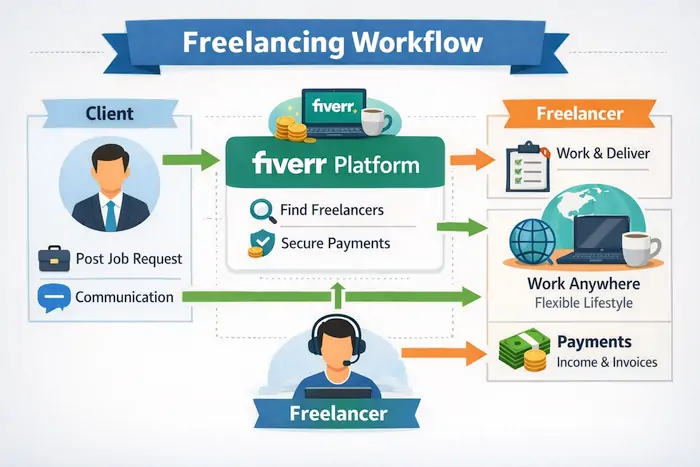
Freelancing is simple: you sell your skills as a service. You might charge per hour, per project, or a fixed price. Your clients can be across the street, or across the planet.
What is freelancing? In plain terms, it’s independent online work without a boss hovering over your shoulder.
If you have a skill that solves a problem, you can freelance.
And if you don’t yet? You can learn one. Some of the most in-demand freelance categories right now include:
- Writing & Copywriting – blog posts, website copy, product descriptions, UX writing, ghostwriting, technical writing
- Graphic Design – logos, brand identity, social media graphics, UI/UX design, print materials
- Web & App Development – front-end, back-end, WordPress, Shopify, mobile apps, API integrations
- Video & Audio – video editing, YouTube production, voiceover, podcast editing, motion graphics, animation
- Marketing & SEO – social media management, email campaigns, SEO strategy, paid ads (Google/Meta), content marketing
- Virtual Assistance & Admin – data entry, calendar management, customer support, research, project coordination
- Online Education & Coaching – tutoring, online course creation, career coaching, language instruction, mentorship
- Photography & Photo Editing – photo retouching, stock photography, product photography editing
- AI-Assisted Services – prompt writing, AI editing, chatbot setup, workflow automation (this one’s exploding right now)
Why Freelancing Is So Appealing
Benefits of freelancing – flexible schedule and financial freedom (aka, control over your life).

Flexibility — Work at 7 a.m., midnight, or not at all today. Home office, café, beach (sunburn optional). Freelancing is the backbone of the digital nomad lifestyle.
Unlimited earning potential – You set your rates, negotiate your terms, and can work with multiple clients simultaneously. There’s no salary cap.
Project variety – Instead of repeating the same tasks year after year, you collaborate with clients across different industries. Every project sharpens your skills.
Career ownership – Freelancing pushes you to stay sharp, stay organized, and constantly improve. You develop entrepreneurial skills you simply can’t build in a traditional job.

Access to global clients – You’re not limited to your local job market. US clients, European startups, global brands , all are within reach. Rates are typically paid in USD, which makes freelancing especially valuable for those outside the US as well.
How to Start Freelancing : Step by Step
1. Choose Your Skill and Niche
Start with what you already know, or what genuinely interests you. The narrower your niche, the less competition you face and the higher rates you can charge.
“Email marketing specialist for e-commerce brands” beats “copywriter who does everything.”
For freelancing for beginners, picking one focused service is more important than being versatile.
2. Build and Sharpen Your Skills
Use free and paid resources to get up to speed quickly: Coursera, Skillshare, Udemy, LinkedIn Learning, YouTube tutorials, and Google’s free certification programs. Many platforms also publish guides on the most in-demand skills in each category – use them.
3. Build a Portfolio
Your portfolio is your #1 sales tool.
Include:
- 3–5 examples of your best work (personal projects or free work are fine to start)
- A brief description of each project and the result it achieved
- Links to your profiles on freelance platforms
Free tools for building a quick, professional portfolio: Google Sites, Contra (purpose-built for freelancers), Behance (designers), GitHub (developers), or a simple Notion page.
4. Sign Up on Platforms
Choose one or two platforms (see the comparison below) and fill out your profile carefully ; professional photo, clear service description, skills, certifications, and work samples. A well-built profile is worth 2–3 hours of your time.
5. Send Your First Proposals
In the beginning, accept smaller projects to build reviews and reputation. Five genuine five-star reviews are worth more than a perfect profile with zero ratings.
Freelancing for beginners tip: Write personalized proposals , avoid copy-paste templates. Address the client’s specific problem and explain clearly how you’ll solve it.
6. Deliver More Than Expected
A happy client is your most powerful marketing tool. Quality, reliability, and clear communication will earn you referrals and repeat work. Most experienced freelancers get the majority of their revenue from returning clients and word-of-mouth.
Freelance Platform Comparison
| Platform | Focus | Commission | Best For |
|---|---|---|---|
| Fiverr | All categories | 20% | Beginners, gig model |
| Upwork | All categories | 5–20% | Long-term projects |
| Freelancer.com | All categories | 10% | Competitive bidding |
| Toptal | IT, design, finance | Variable | Top-tier experts |
| Guru | All categories | 5–9% | Long-term relationships |
| Contra | All categories | 0% | US market, no fees |
| LinkedIn ProFinder | Professional services | Variable | B2B, service pros |
The Best Freelance Platforms in 2026
Fiverr : Gig Model, Perfect for Freelancing for Beginners
Fiverr runs on a “gig” model — you create a fixed-price service offer (starting from $5), and clients come to you. Unlike Upwork, you don’t have to actively search and apply for jobs.
Pros: Easy to set up, global audience, clients come to you, scalable packages (Basic / Standard / Premium).
Cons: High competition at entry level, 20% platform commission, lower starting prices.
Verdict: The best first step for freelancing for beginners. Works especially well for graphic design, writing, translation, video editing, and digital marketing.
If you are an affiliate marketer, you can sign up as a Fiverr affiliate and earn a commission when someone orders a service.
Upwork : Largest Global Freelance Platform
Upwork is one of the world’s largest freelancing platforms, with millions of active clients and freelancers. You submit proposals on posted projects, or clients invite you directly.

Pros: Massive global marketplace, long-term project opportunities, detailed freelancer profiles with earnings history, secure payments via escrow.
Cons: 20% commission on the first $500 earned per client (drops to 10%, then 5% as you earn more with the same client), competitive for new freelancers, requires “Connects” credits to apply.
Verdict: Excellent for building lasting client relationships. Top categories: web development, writing, digital marketing, virtual assistance.
Freelancer.com : Competitive Bidding Platform
Freelancer.com works on a bid model — clients post projects, freelancers submit proposals, and the client selects the best fit. There’s also a design contest feature where freelancers submit work for a prize.

Pros: Wide variety of projects, client rating system, design contest opportunities.
Cons: High competition, low initial prices, some reviews note unreliable clients.
Toptal : Platform for Top-Tier Experts
Toptal is an exclusive network that accepts only the top 3% of applicants. The screening process is rigorous , multiple interviews and technical assessments – but the payoff is access to high-quality clients and significantly higher rates.

Pros: Premium projects, Fortune 500 and top startup clients, Toptal matches you with projects instead of you chasing clients.
Cons: Demanding and lengthy application process, not suitable for beginners.
Verdict: A worthy long-term goal for experienced developers, designers, and financial experts.
Guru : For Long-Term Client Relationships
Guru offers lower commissions than Upwork (5–9%) with an emphasis on ongoing collaboration. Its WorkRoom feature makes it easy to communicate, share files, and track project progress.

Pros: Lower commission, solid project management tools, secure payments.
Cons: Smaller user base than Upwork or Fiverr, fewer new job postings.
Contra : Zero Commission, Growing Fast
Contra is a newer US-based freelance platform that charges 0% commission , both for freelancers and clients.
It’s grown rapidly among US-based creatives, developers, and marketers, and is particularly popular with the Gen Z freelance community.

Pros: Zero fees, clean modern interface, strong community, portfolio tools built in.
Cons: Smaller client pool than Upwork or Fiverr, still building its marketplace depth.
Verdict: A great addition to your platform mix, especially if you’re targeting US clients and want to keep 100% of your earnings.
LinkedIn ProFinder
For professionals offering consulting, coaching, design, writing, or business services, LinkedIn ProFinder connects you directly with business clients through your existing LinkedIn profile. It’s particularly effective for B2B services and higher-ticket projects.
Verdict: Worth setting up if you already have a strong LinkedIn presence and are targeting corporate or professional clients.
6 Freelancing Tips for Long-Term Success
- Specialize : A generalist struggles to stand out; a specialist commands higher rates. It’s better to be exceptional at one thing than average at everything.
- Your profile is your storefront : A professional photo, a clear headline, strong work samples, and precisely defined services make a huge difference in inquiry volume.
- Communicate clearly and quickly : Clients value responsiveness above almost everything else. Reply within a few hours, even just to confirm you received the message.
- Always deliver more than you promise : One satisfied client brings a review, a referral, and repeat business. That’s the foundation of a sustainable freelance career.
- Diversify : Don’t rely on a single client or a single platform. Algorithms change, clients disappear. Spread your risk.
- Stay ahead of AI trends : AI tools are reshaping copywriting, design, and even development. Freelancers who learn to work with AI tools early will have a clear edge over those who ignore them.
Frequently Asked Questions

Get the latest news!
Get useful tips in your inbox once a week. Free. Just useful stuff.
Conclusion
Freelancing for beginners is one of the most realistic ways to make money online today.
But let’s be clear, it’s not magic, and it’s not instant.
The people who succeed are the ones who keep learning, keep improving, and keep showing up even when it feels awkward.
Start small. One skill. One platform. One client.
Then repeat.
And when someone trusts you with their project? Do the work like your reputation depends on it , because it does.